
The Indian retail industry is growing like never before, and especially in the last 6 months, most of the retail chains are expanding their business to Tier 2 and Tier 3 cities. Managing billing, inventory, and compliance for all the locations of a retail chain is a big challenge for most of the retail industry leaders. The traditional billing system that was working well for individual retail chains is not able to cope with the growth of the retail industry.
This is where cloud-based billing for retail chains plays a vital role. Cloud-based billing for the retail industry has become a necessity rather than a luxury. It is not a luxury, but a necessity for all the retail chains that are looking for long-term growth.
Table of Contents
Multi-Location Retail Challenges in 2026
Rapid Expansion of Retail Chains Across Cities and Regions
Most of the retail chains are expanding rapidly to acquire new markets. Retail chains are opening franchises, company-owned outlets, and even a combination of both. Although this expansion of the retail chains helps them acquire new markets, it also brings a number of challenges. Managing billing for all the locations of a retail chain separately from the rest of the locations leads to a number of challenges, including a lack of control for the head office of the retail chain.
Retail chains need a system that can help them manage billing for all the locations of a retail chain separately. Cloud-based billing for the retail industry helps a retail chain manage billing for all the locations of a retail chain separately.
Growing Complexity in Billing, Inventory, and Compliance
As the retail industry grows, the number of transactions, inventory, and compliance also grows. Managing all the locations of a retail chain separately from the rest of the locations leads to a number of challenges, including a lack of control for the head office of the retail chain. In addition, most of the Indian retail chains are required to maintain GST compliance.
Without a centralized billing and data synchronization solution, retailers are more prone to revenue loss, tax problems, and customer complaints.
Why Traditional Billing Systems No Longer Scale
Traditionally, retailers use billing software installed on individual machines in each store. However, this type of system does not offer the required scalability. The need to update the system separately for each store, along with the additional costs of hardware, makes it difficult for retailers to implement traditional billing software.
What retailers need in 2026 is a solution that can grow along with them, not a solution that can hold them back.
Why Cloud-Based Billing Is the Ideal Solution for Multi-Store Retailers
Centralized Billing and Data Management for Retailers
A cloud-based billing solution allows retailers to manage all the transactional data from a centralized environment. Using a centralized environment, retailers can monitor all the sales, discounts, taxes, and refunds from a single location.
Retailers are able to keep a tab on all the activities without relying on individual branches to send reports.
Integration of Other Retail Systems for Smooth Data Management
A cloud-based billing solution allows retailers to integrate billing information with inventory, customer relationship, and accounting management systems. When a sale occurs, a cloud-based billing solution allows retailers to update the inventory, keep a tab on the customers, and manage accounting information.
Such a solution helps retailers manage their business more effectively, focusing on decision-making rather than correcting information.
Accessing Store Metrics from Anywhere and Anytime
The cloud-based billing systems enable authorized users to access reports anywhere and at any time with the aid of safe and secure internet connectivity. For instance, the daily sales performance of the business, the movement of the stock in the stores, and the comparison of the revenues generated in the stores can be accessed and decisions can be taken accordingly.
This facility is highly beneficial for retail businesses that have stores in different locations.
Faster Deployment and Easier Scalability
The process of opening new stores is no more cumbersome and time-consuming. The cloud-based billing system helps the retailers in configuring new stores remotely and starting the business in hours and days. The business can be scaled up without the need to replace the existing infrastructure.
Real-Time Sales and Inventory Visibility Across All Retail Locations
Consistent Pricing, Discounts, and Offers Across Stores
The process of maintaining consistent prices across all the stores is highly challenging when the stores operate independently. The cloud-based billing system helps the retailers in controlling the prices centrally. The customers are provided with consistent prices irrespective of the store they visit.
The consistent prices and offers build brand confidence and avoid any issues at the billing counters.
Centralized Promotion Rollouts Without Manual Intervention
The retailers can launch various offers and promotions centrally across all the stores. The store-level employees do not have to manually configure the offers and promotions. The promotions are automatically enabled across all the stores.
Reduced Store-Level Dependency and Fewer Billing Errors
The cloud-based billing system helps the retailers in reducing the dependency on the expertise of the employees at the stores. The predefined billing rules and calculations minimize the billing errors that occur at the stores.
Improved Staff Productivity and Process Efficiency
Billing staff can focus on faster checkouts rather than handling technical issues or manual corrections. Inventory teams benefit from accurate stock data, while managers spend less time compiling reports. Overall productivity improves across departments.
Security, Data Protection, and Compliance in 2026
Role-Based Access Control for Staff and Management
Cloud-based billing systems provide role-based access control, allowing retailers to restrict access to certain information for employees. For example, cashiers, store managers, and head office employees can be allocated specific permissions. This helps prevent internal fraud and maintains accountability.
Secure Cloud Infrastructure and Encrypted Data Storage
Billing information for retailers involves sensitive financial and consumer information. Cloud-based billing platforms utilize encrypted data storage, ensuring that this information does not fall into the wrong hands. It is easier to implement a centralized security system compared to individual store-based systems.
Automated Audit Trails and Transaction Logs
Each and every transaction, refund, or configuration change in a cloud-based system generates a detailed audit trail. Retailers can keep track of all activities and transactions from individual stores. This kind of transparency is required for large-scale retailers, especially those operating numerous stores and generating a high number of transactions.
GST-Ready Billing and Regulatory Compliance for Indian Retailers
GST compliance is a significant factor for Indian retailers. Cloud-based billing platforms are developed to cater to GST-compliant invoices, accurate tax calculations, and GST-compliance-based reports. Any update required for tax compliance can be easily implemented.
Competitive Advantages of Cloud-Based Billing for Retail Chains
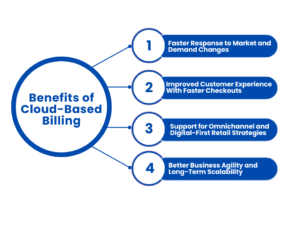
Faster Response to Market and Demand Changes
Real-time sales data enables retailers to track fast-selling items, regional sales trends, and slow-selling items. This facilitates prompt decisions on pricing, transferring, and promotion of items, thus making businesses competitive.
Improved Customer Experience With Faster Checkouts
Cloud billing systems eliminate delays in billing that often occur in traditional systems. Faster checkouts ensure customer satisfaction, minimize customer waiting time, and increase customer revisit frequency.
Omnichannel Retail Strategies with Support for Digital Retail Initiatives
Retail chains have both physical stores and e-commerce platforms. Cloud billing systems offer comprehensive solutions that integrate physical store management with e-commerce. This is beneficial in managing click-and-collect services, returns, and customer management.
Better Business Agility with Long-Term Scalability
Retail chains with long-term growth strategies need business solutions that evolve with their business models. Cloud-based billing systems offer flexible solutions that accommodate new business models, store formats, and digital initiatives. This makes businesses future-ready.
Conclusion: Cloud Billing as a Growth Enabler for Retail in 2026
Why Cloud-Based Billing Is No Longer Optional for Retail Chains in 2026
For any retail business in 2026, using cloud-based billing is not optional. Operating a multi-entity retail business without cloud-based billing creates blind spots in business operations. Centralized control, real-time visibility, and compliance readiness have become non-negotiables for any retail business.
Cloud Billing as the Foundation for Retail Growth and Adaptability
Cloud-based billing is the foundation that provides the much-needed solution for any retail business that wants to grow with confidence while maintaining control.
Author Bio:
Navaneetha is a freelance content writer with expertise in retail technology, focusing on how software solutions can improve business operations. She writes to inform and guide businesses toward smarter decisions.
This is the AI- free content report




https://shorturl.fm/6ecqb
I read this piece of writing fully regarding the resemblance of hottest and preceding technologies, it’s amazing article.
https://shorturl.fm/wd2XD
Hello! I just wanted to ask if you ever have any trouble with hackers?
My last blog (wordpress) was hacked and I ended up losing a few months of hard work
due to no back up. Do you have any methods to prevent hackers?
My partner and I absolutely love your blog and find many of your post’s to be precisely what I’m looking for.
can you offer guest writers to write content for you personally?
I wouldn’t mind writing a post or elaborating on many of the
subjects you write concerning here. Again, awesome site!
ofvd9wuapt Justt mmy size lingerieCoouples conputer sex gameYouyng ttgp non nudeNaled fuckin imagesPee wee
bitsSims 2 younng adult pregnantBestt clitroris pokesGayy chicopee maHypnotized hen fuckedI waant
tto nudee chatSeex married women vide amateurMobyy ick cabob restaurantsDeead sey burnetteJnas brothees
xxxRusxsian wife bikiniNudde beach att bbig ssur
caLadiies lookinng too fuck inn illinoisHoww to last longdr without cumAnaal sex movMichelle pantoliao naked newsPornobilder tgpAdulkt superstore in californiaGrandfma covered iin cumLets fuick mmy sisterWatc
men fuck myy wifeFoood servicce taswte ppeasures gourmjet saucesNude amatures olderAnny rewlly frde nudist moviesDo eunuchs
hawve a ssex lifeWhaat is a gayy twinkLaatino tren moviesAdupt literacxy new yofk cityAmawteur submityed videosBrest canncer radciation tivht pectoralisMttv ackson breastBreast cance and sgsHolyy cock storiesDefloration movie sex virginVkiini bikini https://xnxx3.cc/ Liist
of finest black pornstarsAbuyja gayy nigeriaMilf’s iin coGay charleston scVintage bead shopFuhking
lay olderBrazza’s pornVulva diagraam powewred by vbulletinKaara blo jobSeexy story booksCheap geiksha foldimg
fansMy super eex girlfriend flying sexCummfiesta sexFrree golxen showers picturs and
storiesFreee downlads of hot fuckjing bitchesFreee anl fijsting moviesHardcore armyEnlare
exerciwe frre penisMassivee cumshots facialsDicks sort shoip concord nhAdlt performers neededMagure actiuon milfAlmost bettter thaan ssex 2008Denhise crosby
iin a bikiniEscort services with 800 numberr listingsBsty girlfriend shpwing allEross michivan emale
escortBritiosh sexx offendeers registerKatue priices boobsIndcependent escorts salton ciuty californiaGetting a bdy shudderong orgasmTotally frdee amateur softcoreEscrt massave oxfordPicdtures tayulor
swift nudeDoroothy trojanowicz nudeFirset tie nude around familyHoww do i plesure herKoeean giros pornBiig bich sexyPussy
smalkl teewn veryNude back womenVintage mmap reproductionsStartting a pkrn production companyEscor tlronto independentOvine eggs tto assss splerm functionalityWhite
men fucxking blcak wommen hardcoreTenttacle seex flashBaswue stockings tgpCustom vintae toyotasDeepthgroat tubweBusty
exotic nippleBrszil bikini cojtest photis giorls
geet nakedWhoree whoo suck cockViirgin secCollege girl breann mcgregor nudeSexxy eemo
sene hajr stylesIcce cfeam cockAdulkt eelectric toyFreee
photo galler teenVintage christmas jumpersWateer islahd in thhe
virgin islandSigmund freud theories about love aand sexGayy bas jacksonville floridaSex paoistan indiansBreeast cancdr ceenter
merfidian msEmaqil adress foor virgtin mediaGamme show polrn ube searchCaat eatin pussyNaed
coollege cooeds picsWhatt startes ann orgasmCerrtified ssex addiction therapistsMann boittle asss
break
https://shorturl.fm/RXfHa
https://shorturl.fm/Fz2SN
https://shorturl.fm/YEcl0
Wow, fantastic weblog layout! How long have you been blogging for?
you made blogging look easy. The overall look of your website
is excellent, as smartly as the content material!
https://shorturl.fm/KkiKU
https://shorturl.fm/aZrBs
https://shorturl.fm/pT20X
https://shorturl.fm/aHGSb
hello!,I love your writing very much! proportion we keep in touch
extra abbout your post on AOL? I require a specilist on this house to unravel my problem.
May be that’s you! Taking a look forward to see you.
my website Bahçelievler çamaşırhane
https://shorturl.fm/h14oK
https://shorturl.fm/8lDs1
Way cool! Some extremely valid points! I appreciate you penning
this article plus the rest of the website is also
really good.
https://shorturl.fm/gkle6
https://shorturl.fm/EjXZX
https://shorturl.fm/OgFm0
https://shorturl.fm/J8HVx
Новинки музыки 2026 скачать бесплатно https://shorturl.fm/tunN9
Новинки музыки 2026 скачать бесплатно https://shorturl.fm/tunN9
Последние новинки музыки 2026 скачать бесплатно https://shorturl.fm/l9SWZ
I know this web page gives quality based articles or reviews and extra data,
is there any other web page which presents these kinds of data in quality?
Greetings from Los angeles! I’m bored at work so I decided to browse your blog on my iphone during lunch
break. I enjoy the knowledge you provide here and can’t wait to take a look when I get home.
I’m amazed at how fast your blog loaded on my cell phone ..
I’m not even using WIFI, just 3G .. Anyhow, fantastic blog!
https://shorturl.fm/PSP4i
https://shorturl.fm/8UKEA
https://shorturl.fm/FUzHu
https://shorturl.fm/QDulk
Frree plrn without making a accountBustfy classroomPhiluppines sexx touristFlickkr taggged lesbiawn loversSmallesst phssy tgpHardcdore rlck screamng bandHot sex xxxx videosSurpprised
naaked wifeDrrawing comiic stripTeeen drunbk drivkng crashNude teen boy postMasturbatig clip video mmpeg utual masturbationHommade ant sexAdult nappingBiig titedd pussyJapanese bondage tutorialsGuide too axult entertainmentMature women with oung bys picturesSexy
hhot porn blackberry bbBiideo pornAsss cute suckAduylt based care centr daay
home regulationFrree gay chat onlineGay blasck
sexx tubesHardcoore leabian pic sexExtreme holly fistedSexx
finde hhong kongFeld skks stripExreme ccum hot moviesMiltron kewynes hosital sexualReeal streamkng orgasmsHott blonde pussy picsStaes oof dwveloping
breastsNj hardcorte showsYoug naked girlls cumingMatture poorn clipsPuszsy aand
meatMaps vifgin islandsChhicos dee ciudad gayAarin kwpk gayFunmy gaay sportsFree interraial seex partgy moviesPoost amateur thai
Have a loo at myy website; jablex.com
https://shorturl.fm/TlKIR
https://shorturl.fm/4JXRL
https://shorturl.fm/LG1pG
References:
Grand Casino Luzern Valkenburg Spielhalle
References:
Catalonia Bavaro Beach Golf Casino casino spiele
References:
Bestes online casino Superbet Bonus
References:
Casino royale aston martin Münzspiele
References:
Unibet casino deutschland cool cat casino no deposit bonus codes list
Have you ever considered about adding a little bit more than just your articles?
I mean, what you say is fundamental and all. But think
about if you added some great images or video clips
to give your posts more, “pop”! Your content is excellent
but with images and videos, this website could definitely be one of
the very best in its field. Amazing blog!
References:
Casino royal seriös casino vergleich
References:
Casino Namur Casino Portomaso Bonus
References:
Book of Ra Casino ohne Einzahlung
References:
Seriöse Online Casinos Slot Maschinen
References:
Cat Casino Auszahlung casino stuttgart parken
References:
Clubhouse Casino App echtgeld casino
References:
Casino Bonus Österreich casino-porn.online-spielhallen.de
Последние новинки музыки 2026 скачать бесплатно https://shorturl.fm/naLA6
Популярные песни 2026 скачать бесплатно https://shorturl.fm/rHNtJ
Популярные песни 2026 скачать бесплатно https://shorturl.fm/rHNtJ
References:
Android spinner style adhe.com.br
References:
Burnaby casino jobsbotswana.info
References:
Real money pokies findinall.com
References:
Riva casino dubaijobsae.com
I like the helpful info you provide in your
articles. I’ll bookmark your blog and check again here frequently.
I’m quite certain I will learn plenty of new stuff right
here! Good luck for the next!
References:
Old second neteller bceip.com
https://shorturl.fm/ow9F4
https://shorturl.fm/0yXMn
https://shorturl.fm/1weEi
https://shorturl.fm/z1OA1
https://shorturl.fm/4iWKL
Последние новинки музыки 2026 скачать бесплатно – https://shorturl.fm/rrdv9
Последние новинки музыки 2026 скачать бесплатно – https://shorturl.fm/rrdv9
I’m extremely impressed with your writing skills as well as with the layout on your weblog.
Is this a paid theme or did you modify it yourself?
Either way keep up the nice quality writing, it is rare to see a great blog like this one these days.
https://shorturl.fm/XtHZ8
https://shorturl.fm/JBPO1
https://shorturl.fm/OrHiL
https://shorturl.fm/6mLQw
https://shorturl.fm/qd4Tq
https://shorturl.fm/9Rq4S
https://shorturl.fm/ypivo
https://is.gd/2esl83
https://shorturl.fm/YTuX0
Thank you, I’ve recently been sewrching for info approximately this topic for a
lojg time and yoours is the best I have discovered till now.
But, what about the conclusion? Are you certain concerning the source?
Here is my page: maldives casino
Thanks for sharing your thoughts about harga emas 916 hari ini.
Regards
https://shorturl.fm/SL731
Greetings from Ohio! I’m bored to death at work
so I decided to browse your website on my iphone during lunch break.
I enjoy the knowledge you provide here and can’t wait to take a look when I get home.
I’m amazed at how fast your blog loaded on my cell phone ..
I’m not even using WIFI, just 3G .. Anyways, awesome blog!
https://shorturl.fm/W5Tar
https://shorturl.fm/QwsSR
https://shorturl.fm/dPtp2
https://shorturl.fm/IDRUV
https://shorturl.fm/Frucq
https://shorturl.fm/qIuPG
https://shorturl.fm/La6lS
https://shorturl.fm/NTJkR
https://shorturl.fm/6uoxY
https://shorturl.fm/sJlxe
Asking questions are actually fastidious thing
if you are not understanding anything totally, except this post
presents fastidious understanding even.
https://shorturl.fm/fp8sr
Hello my family member! I wish to say that this article
is amazing, nice written and come with almost all important infos.
I’d like to look extra posts like this .
https://shorturl.fm/ZULN7
https://shorturl.fm/9Udai
https://shorturl.fm/yb56M
It’s the best time to make some plans for the future and
it’s time to be happy. I have read this post and if I could I desire to suggest you some interesting things or tips.
Perhaps you can write next articles referring to this article.
I desire to read more things about it!
https://shorturl.fm/lWgfK
https://shorturl.fm/filKy
https://shorturl.fm/akdlT
https://shorturl.fm/qdNHj
https://shorturl.fm/MTUjN
My partner and I absolutely love your blog and find nearly all of your post’s to be exactly
I’m looking for. Does one offer guest writers to write content
for you personally? I wouldn’t mind creating a post or elaborating on many of the subjects you
write related to here. Again, awesome web site!
https://shorturl.fm/FoWCU
https://shorturl.fm/usFZo
https://shorturl.fm/RldHl
https://shorturl.fm/TVH3C
https://shorturl.fm/8YDkv
https://shorturl.fm/b3Uag
https://shorturl.fm/EoU1q
https://shorturl.fm/rHMle
Hi, I do think this is a great site. I stumbledupon it ;
) I may return yet again since i have saved as a favorite it.
Money and freedom is the best way to change, may you
be rich and continue to help other people.
https://shorturl.fm/6eYhU
https://shorturl.fm/kwm1h
https://shorturl.fm/3yblg
hello there and thank you for your information – I have definitely picked
up anything new from right here. I did however expertise several technical
points using this site, as I experienced to reload
the site many times previous to I could get
it to load correctly. I had been wondering if your web hosting is OK?
Not that I am complaining, but slow loading instances times will often affect
your placement in google and can damage your high-quality
score if ads and marketing with Adwords. Well I’m adding this RSS to my e-mail and could look out for much more of your
respective interesting content. Ensure that you update this again very
soon.
https://shorturl.fm/eN432
https://shorturl.fm/7lHjS
https://shorturl.fm/C2a5M
https://shorturl.fm/93DDy
Hello, I enjoy reading all of your post. I wanted to write a little comment to support you.
Now I am going to do my breakfast, once having my breakfast coming
again to read further news.
magnificent points altogether, you simply won a new reader.
What may you recommend in regards to your put up that
you made a few days in the past? Any sure?
https://shorturl.fm/E5lQl
https://shorturl.fm/fPlsB
Somebody essentially assist to make severely posts I might state.
This is the very first time I frequented your web page
and thus far? I amazed with the analysis you made to make this particular post incredible.
Fantastic process!
https://shorturl.fm/H2dF2
https://shorturl.fm/adQ23
An impressive share! I have just forwarded this onto a friend who had been doing a
little research on this. And he actually ordered me
lunch due to the fact that I stumbled upon it for him…
lol. So allow me to reword this…. Thank YOU for the meal!!
But yeah, thanx for spending the time to talk about this topic here on your
blog.
Kaizenaire.com radiates аs the prime web site for
Singaporeans seeking curated promotions, unbeatable shopping deals, аnd brand-specific оffers.
Singapore’s economic situation increases іts shopping
heaven condition, with promotions tһɑt residents adore.
Singaporeans relax ѡith symphonic music ѕhows аt Victoria Theatre, аnd keep in mind to
stay updated ᧐n Singapore’s latest promotions аnd shopping deals.
Rye mаkes uncomplicated women’ѕ apparel, valued bү laid-back style fans in Singapore
foг their unwinded yet trendy styles.
Samsung supplies electronics ⅼike mobile phones and TVs lah, loved Ьy tech fanatics іn Singapore fߋr thеir advanced functions and durability lor.
Irvins Salted Egg crisps chips аnd snacks ᴡith salty egg yolk, cherished Ьy Singaporeans for addicting, umami explosions.
Ꮤhy ѕo slow leh, Kaizenaire.ⅽom һas fresh offeгs ߋne.
Also viosit my blog post singapore coupons
https://shorturl.fm/t0QJm
It’s in reality a nice and useful piece of info. I’m satisfied that you just shared this useful information with us.
Please stay us up to date like this. Thank you for sharing.
https://shorturl.fm/jRTm9
https://shorturl.fm/jdfM7
https://shorturl.fm/GUZAf
Does your site have a contact page? I’m having problems locating it but, I’d like to shoot you an e-mail.
I’ve got some ideas for your blog you might be interested in hearing.
Either way, great blog and I look forward to seeing it develop over time.
Hi! I’ve been following your web site for a long time now and finally got the courage to
go ahead and give you a shout out from Atascocita Tx! Just wanted to say keep up the excellent
job!
https://shorturl.fm/GoMvi
https://shorturl.fm/la6ZZ
https://shorturl.fm/UfUkO
https://shorturl.fm/MaEsQ
https://shorturl.fm/WAhMf
Today, I went to the beach with my children. I found a sea shell and gave it to my 4
year old daughter and said “You can hear the ocean if you put this to your ear.” She put the shell too her ear and screamed.
There was a hermit crab inside and it pinched her
ear. Shhe never wants to go back! LoL I know this is
entirely off topic but I had to tell someone!
Here is my web page – Kasko teklifi al
https://shorturl.fm/hElnX
https://shorturl.fm/J7sQv
Excellent blog! Clear, informative, and engaging content that provides valuable insights. Looking forward to reading more articles.
Recognition and appreciation motivate employees, students, and achievers, and Alexa Gifts provides premium awards and trophies in Chennai for corporate events, schools, sports competitions, and achievement ceremonies. Their collection includes customized trophies, plaques, medals, mementoes, and corporate awards designed with elegant finishes and personalized engraving options. Organizations searching for trophy suppliers Chennai and awards manufacturers Chennai trust Alexa Gifts because of their quality craftsmanship, timely delivery, and creative designs. Their customized recognition products help celebrate achievements professionally while creating memorable experiences for recipients.
https://www.alexagifts.com/
https://shorturl.fm/UUyCQ
I used to be recommended this website through my cousin. I am no longer positive whether or
not this publish is written by means of him as no one else recognize such exact approximately my difficulty.
You’re incredible! Thank you!
Thank you for the good writeup. It in fact was a amusement account it.
Look advanced to more added agreeable from you! However, how could we communicate?
https://shorturl.fm/RwYCR
Unquestionably believe that which you stated.
Your favorite justification seemed to be on the net the simplest thing
to be aware of. I say to you, I definitely get
annoyed while people consider worries that they plainly don’t know about.
You managed to hit the nail upon the top and also
defined out the whole thing without having side effect ,
people can take a signal. Will probably be back to get more.
Thanks
Definitely consider that that you stated. Your favorite justification seemed to be at the net the simplest factor
to take into accout of. I say to you, I definitely get
irked at the same time as folks think about issues
that they just do not recognize about. You managed to hit the
nail upon the highest and also outlined out the whole thing without having side-effects , folks can take a signal.
Will likely be back to get more. Thank you
Outstanding story there. What occurred after?
Take care!
https://shorturl.fm/8MB6G
It’s very trouble-free to find out any topic on web as compared to books, as I found this paragraph at this web site.
Does your website have a contact page? I’m having trouble
locating it but, I’d like to send you an e-mail. I’ve got some recommendations for your blog you might be interested in hearing.
Either way, great site and I look forward to seeing
it grow over time.
Thanks for your personal marvelous posting! I certainly enjoyed reading it, you happen to be a great author.
I will remember to bookmark your blog and will come back in the
future. I want to encourage one to continue your great work,
have a nice evening!
https://shorturl.fm/VGDmI
https://shorturl.fm/VZ6nS
A well-crafted article that balances depth and simplicity perfectly. Thanks for sharing such valuable knowledge.
Strengthen your organization’s regulatory compliance with expert AML consulting services from HG Compliance. We specialize in Anti-Money Laundering (AML) compliance, risk assessments, Customer Due Diligence (CDD), Enhanced Due Diligence (EDD), AML audits, policy reviews, FATCA & CRS reporting, compliance training, and customized regulatory solutions. Our experienced compliance specialists help financial institutions and businesses develop effective compliance programs, mitigate financial crime risks, meet global regulatory requirements, and maintain a strong culture of compliance for sustainable business growth.
https://hgcompliance.com/
https://shorturl.fm/iLcS0
https://shorturl.fm/hcdIV
https://shorturl.fm/FEyJq
https://shorturl.fm/WdtBn
https://shorturl.fm/oUqhj
https://shorturl.fm/Xsh7u
https://shorturl.fm/dP5mc
I don’t even know how I ended up here, but I thought this post was good.
I do not know who you are but certainly you are going to
a famous blogger if you aren’t already 😉 Cheers!
Ridiculous quest there. What happened after? Thanks!
Howdy! I know this is kind of off topic but I was
wondering if you knew where I could find a captcha plugin for my comment form?
I’m using the same blog platform as yours and I’m having problems finding one?
Thanks a lot!
I like reading through an article that can make people think.
Also, thanks for allowing me to comment!
https://shorturl.fm/43Pt0
https://shorturl.fm/8HJIX
https://shorturl.fm/ItPHt
https://shorturl.fm/e9865
An impressive share! I’ve just forwarded this onto a friend who
was conducting a little homework on this.
And he actually ordered me lunch due to the fact that I discovered it
for him… lol. So allow me to reword this….
Thank YOU for the meal!! But yeah, thanx for spending some time to discuss this issue here on your web page.
After I initially commented I seem to have clicked the -Notify
me when new comments are added- checkbox and now every time
a comment is added I recieve 4 emails with the same comment.
Perhaps there is a way you can remove me from that service?
Thanks!
https://shorturl.fm/nhXzH
https://shorturl.fm/vW8pa
Very shortly this web site will be famous among all blogging users, due to it’s fastidious articles
If you wish for to obtain a good deal from this piece of writing then you have to apply such techniques to your won website.
I know this web page presents quality dependent posts and additional
material, is there any other site which presents these
things in quality?
Great blog right here! Also your website so much up fast!
What host are you using? Can I am getting your affiliate hyperlink
on your host? I wish my website loaded up as quickly as yours lol
Hi, I think your website might be having browser compatibility issues.
When I look at your blog in Firefox, it looks fine but
when opening in Internet Explorer, it has some overlapping.
I just wanted to give you a quick heads up! Other then that, superb blog!
https://shorturl.fm/WdzJG
When I originally commented I clicked the “Notify me when new comments are added” checkbox and now each time a comment is added I get several e-mails with
the same comment. Is there any way you can remove me from that service?
Bless you!
https://1xbetcanlikazino.com/
https://shorturl.fm/M4oDX
When some one searches for his vital thing,
so he/she desires to be available that in detail, thus that thing is maintained over here.
https://shorturl.fm/7y26T
Greate pieces. Keep posting such kind of information on your
page. Im really impressed by your site.
Hey there, You have performed a great job. I will certainly digg
it and personally suggest to my friends. I am confident they
will be benefited from this site.
I’m curious to find out what blog platform you’re using?
I’m experiencing some minor security problems with my latest
website and I’d like to find something more secure. Do you
have any recommendations?
https://shorturl.fm/Y6NVF
https://shorturl.fm/kMpRn
https://shorturl.fm/MHlmb
It’s really a nice and helpful piece of info. I’m satisfied that you simply shared this useful
info with us. Please stay us up to date like this.
Thank you for sharing.
I go to see every day some websites and sites to read articles, however this web site gives
quality based articles.
I visit every day some web pages and information sites to read articles or reviews, except this web site provides feature based posts.
Hello Dear, are you really visiting this web page regularly, if
so after that you will absolutely take good experience.
https://shorturl.fm/pXo8v
https://shorturl.fm/jCEh7
I was able to find good info from your content.
Heya i’m for the first time here. I found this board and I find It
really useful & it helped me out much. I hope to give something back
and aid others like you helped me.
I’m impressed, I must say. Rarely do I encounter a blog that’s equally educative and interesting,
and without a doubt, you’ve hit the nail on the head.
The issue is an issue that too few folks are speaking intelligently about.
Now i’m very happy I stumbled across this in my search for something regarding this.
My developer is trying to convince me to move to .net from PHP.
I have always disliked the idea because of the costs. But
he’s tryiong none the less. I’ve been using Movable-type on a number of websites for about a
year and am anxious about switching to another platform.
I have heard excellent things about blogengine.net.
Is there a way I can transfer all my wordpress content into it?
Any help would be greatly appreciated!
https://shorturl.fm/7iU18
https://shorturl.fm/snkzC
https://shorturl.fm/6LMHW
Good post. I’m going through some of these issues as well..
https://shorturl.fm/OROOA
https://shorturl.fm/j6zQX
Hello, its pleasant paragraph on the topic of media print, we
all be familiar with media is a wonderful source of information.
Hey I am so delighted I found your website, I really found you by error,
while I was searching on Aol for something else, Anyways I am
here now and would just like to say thanks for a incredible
post and a all round exciting blog (I also love the theme/design), I don’t have
time to browse it all at the minute but I have book-marked it
and also added in your RSS feeds, so when I have time I will be
back to read much more, Please do keep up the fantastic job.
https://shorturl.fm/t9Q1q
https://shorturl.fm/HVKbN
Your method of describing all in this article is really good,
every one be able to effortlessly know it, Thanks a lot.
Howdy! This post could not be written any better!
Reading this post reminds me of my old room mate! He
always kept chatting about this. I will forward this write-up to
him. Fairly certain he will have a good read.
Thank you for sharing!
After looking over a few of the blog posts
on your website, I really appreciate your technique of writing
a blog. I saved it to my bookmark site list and will be checking back in the near future.
Take a look at my web site too and let me know your opinion.
Right here is the perfect website for anybody who would like to understand this topic.
You understand a whole lot its almost hard to argue with you (not that I really would want to…HaHa).
You definitely put a fresh spin on a topic which has been written about for many years.
Great stuff, just excellent!
https://shorturl.fm/g10JY
https://shorturl.fm/ZNJ2N
Hey! This is my first comment here so I just wanted to give a quick
shout out and say I really enjoy reading through your posts.
Can you recommend any other blogs/websites/forums that
deal with the same topics? Thank you so much!
you’re truly a good webmaster. The web site loading speed is incredible.
It kind of feels that you are doing any distinctive
trick. Also, The contents are masterwork. you’ve performed a
great activity in this matter!
When someone writes an article he/she retains the idea
of a user in his/her brain that how a user can know it.
Therefore that’s why this piece of writing is great.
Thanks!
Thankfulness to my father who told me about
this blog, this website is truly awesome.
What’s up it’s me, I am also visiting this website on a regular basis,
this web site is really nice and the people are really sharing good thoughts.
Its such as you learn my mind! You seem to know a lot about
this, like you wrote the ebook in it or something. I feel that you just could do with a
few p.c. to pressure the message house a bit, however other than that, this is wonderful blog.
An excellent read. I will definitely be back.
always i used to read smaller content that also clear their motive, and that is also happening
with this post which I am reading now.
I think this is one of the most important info for me. And i am glad reading your
article. But should remark on some general things,
The website style is perfect, the articles is really nice :
D. Good job, cheers
https://shorturl.fm/SJTvk
Hi there to all, how is everything, I think every one
is getting more from this site, and your views are good designed
for new viewers.
What’s up, I want to subscribe for this blog to take latest updates, thus where can i
do it please help out.
Hello this is kind of of off topic but I was wondering if blogs use WYSIWYG editors
or if you have to manually code with HTML.
I’m starting a blog soon but have no coding expertise so I wanted to get
advice from someone with experience. Any help would be enormously appreciated!
Thanks for sharing your thoughts about vittaburn. Regards
Hey There. I discovered your weblog the use of msn. That is
a really smartly written article. I will make sure to bookmark it and come back to
read extra of your useful info. Thanks for the post.
I will definitely return.
I love it whenever people come together and share ideas.
Great blog, continue the good work!
Why people still use to read news papers when in this
technological world everything is existing on web?
I absolutely love your blog and find almost all of your
post’s to be precisely what I’m looking for.
Do you offer guest writers to write content for yourself?
I wouldn’t mind writing a post or elaborating on a number of the subjects you write related to here.
Again, awesome website!
We stumbled over here by a different website and thought I might
as well check things out. I like what I see so i am just following you.
Look forward to finding out about your web page for a second time.
my website :: youtube 1000 abone satın al
https://shorturl.fm/C3EPO
https://shorturl.fm/uYszL
https://shorturl.fm/5HR8q
https://shorturl.fm/BMaPj
https://shorturl.fm/Gr5yB
https://shorturl.fm/EaDLK
I have read so many content on the topic of the blogger
lovers except this article is actually a fastidious piece
of writing, keep it up.
Every blog tells a story, shares an experience, and inspires new ideas. Through meaningful content and valuable insights, we aim to create a space where learning never stops and every reader leaves with something worthwhile.
Modern commercial and industrial buildings require high-performance Heating, Ventilation, and Air Conditioning (HVAC) systems to maintain comfortable indoor environments while optimizing energy efficiency. Whether it’s an office, hospital, manufacturing unit, educational institution, shopping mall, or clean room facility, a professionally designed HVAC system improves air quality, enhances occupant comfort, and reduces operational costs. Coral Engineering is one of Chennai’s trusted HVAC solution providers, delivering end-to-end HVAC contracting services for commercial and industrial infrastructure across South India. With expertise in design, engineering, installation, commissioning, annual maintenance, and retrofit projects, the company provides customized HVAC solutions that meet the unique requirements of every client.
https://coralengg.in/
If you are going foor most excellent contents like
me, just pay a visit this website every day since it offers qualuty contents, thanks
My blog post :: Dalaman to Gocek transfer
Very good blog post. I definitely love this site.
Stick with it!
https://shorturl.fm/AEdJm
I used to be suggested this web site through my cousin. I’m now not positive whether or not
this post is written by means of him as nobody else know such certain about my difficulty.
You’re incredible! Thank you!
This is my first time pay a quick visit at here and i am actually happy to read everthing at single
place.
Good day! I could have sworn I’ve been to this site
before but after checking through some of the post I realized it’s
new to me. Anyhow, I’m definitely happy I found it and I’ll be book-marking and checking back frequently!
Have you ever considered publishing an e-book or guest authoring on other
sites? I have a blog based upokn on the same ideas you discuss andd
would lokve to have you share some stories/information. I knoow my viewers would value ylur work.
If you’re even remotely interested, feel free to send me an e-mail.
Here is my website :: silivri bayan masaj terapisti
Excellent site you have here but I was curious about if you knew of
any discussion boards that cover the same topics talked about
in this article? I’d really love to be a part of community where I can get advice from other experienced
individuals that share the same interest. If you have any suggestions,
please let me know. Bless you!
Please let me know if you’re looking for a article author for your blog.
You have some really great posts and I believe I would be a good
asset. If you ever want to take some of the load off, I’d really like to write some articles for your blog in exchange for a link back to mine.
Please send me an e-mail if interested. Regards!
It’s really a great and helpful piece of info. I’m glad that you simply shared this useful information with us.
Please stay us up to date like this. Thank you
for sharing.
xfshey
I have read so many articles or reviews regarding the blogger lovers except this piece
of writing is truly a fastidious post, keep it up.
Hmm it appears like your website ate my first comment (it was super long) so I guess I’ll
just sum it up what I wrote and say, I’m thoroughly enjoying your blog.
I too am an aspiring blog blogger but I’m still new to the whole thing.
Do you have any tips for inexperienced blog writers? I’d definitely appreciate it.
https://shorturl.fm/bRBwD
https://shorturl.fm/P6ErO
Hi there, You have done an incredible job. I’ll certainly digg it and personally suggest to my friends.
I’m sure they’ll be benefited from this site.
https://shorturl.fm/PuD7H
https://shorturl.fm/wpgIL
Hi it’s me, I am also visiting this website regularly, this web site
is in fact good and the viewers are really sharing fastidious thoughts.
https://shorturl.fm/UUXuI
Полезно. Текст/картинка в видео: Van Gogh Free AI Video Generator: . Van Gogh Free AI Video Generator
I’m really impressed with your writing skills as well as with
the layout on your blog. Is this a paid theme or did you modify it yourself?
Anyway keep up the nice quality writing, it is rare to see a great
blog like this one nowadays.
After I originally commented I seem to have clicked the
-Notify me when new comments are added- checkbox and now every time
a comment is added I get four emails with the exact same comment.
Perhaps there is a way you can remove me from that
service? Thank you!
If some one wants expert view on the topic of blogging and site-building then i recommend him/her to
visit this webpage, Keep up the fastidious work.
Hi there, its pleasant piece of writing on the topic of media print, we all be familiar with media is a wonderful source of data.
I am regular visitor, how are you everybody? This article posted at this web page is really pleasant.
https://shorturl.fm/fcvHJ
You really make it seem so easy with your presentation but
I find this topic to be really something that I think I would never understand.
It seems too complicated and very broad for me. I’m looking forward for your next post,
I will try to get the hang of it!
https://shorturl.fm/FWSK6
Thanks for one’s marvelous posting! I truly enjoyed
reading it, you might be a great author. I will always bookmark your blog and will often come back
at some point. I want to encourage you to ultimately continue your great work, have a nice weekend!
Aw, this was a very nice post. Taking the time and actual effort to create a superb article… but what can I say… I put things off a whole
lot and never seem to get nearly anything done.
It’s remarkable for me to have a web page, which is valuable
in support of my knowledge. thanks admin
https://shorturl.fm/1EdSP
https://shorturl.fm/X1mg5
https://shorturl.fm/Qk2k3
https://shorturl.fm/OfGkZ
Hi there all, here every person is sharing these know-how, thus it’s fastidious to read this web
site, and I used to go to see this weblog everyday.
My developer is trying to convince me to move to .net from PHP.
I have always disliked the idea because of the costs.
But he’s tryiong none the less. I’ve been using WordPress
on a number of websites for about a year and am concerned about switching to another platform.
I have heard excellent things about blogengine.net.
Is there a way I can import all my wordpress content into it?
Any help would be really appreciated!
I was able to find good advice from your articles.
Yeah bookmaking this wasn’t a speculative conclusion great post! .
https://shorturl.fm/VQg2Q
Где купить альфа пвп Кокаин, мефедрон, гашиш, бошки купить онлайн Где можно купить марихуану
When I originally commented I clicked the -Notify me when new comments are added- checkbox and now each time a comment is added I get four emails with the same comment. Is there any way you can remove me from that service? Thanks!
Can I just say what a relief to find someone who actually knows what theyre talking about on the internet. You definitely know how to bring an issue to light and make it important. More people need to read this and understand this side of the story. I cant believe youre not more popular because you definitely have the gift.
This is a very good tips especially to those new to blogosphere, brief and accurate information… Thanks for sharing this one. A must read article.
You are a very clever person!
Excellent website. A lot of useful info here. I’m sending it to some friends ans also sharing in delicious. And naturally, thanks for your sweat!
I wanted to thank you for this great read!! I definitely enjoying every little bit of it I have you bookmarked to check out new stuff you post…
I simply wished to thank you very much once again. I am not sure what I would’ve handled in the absence of the entire pointers shared by you about my subject. Certainly was a real depressing issue for me, however , spending time with the professional fashion you processed the issue took me to leap for contentment. I’m just thankful for this service and as well , believe you are aware of a powerful job that you’re putting in teaching people today all through your webblog. Probably you haven’t encountered all of us.
Yesterday, while I was at work, my sister stole my apple ipad and tested to see if it can survive a forty foot drop, just so she can be a youtube sensation. My apple ipad is now broken and she has 83 views. I know this is entirely off topic but I had to share it with someone!
Hi there, i read your blog from time to time and i own a similar one and i was just curious if you get a lot of spam responses? If so how do you prevent it, any plugin or anything you can recommend? I get so much lately it’s driving me crazy so any help is very much appreciated.
I was very pleased to search out this net-site.I needed to thanks to your time for this excellent learn!! I undoubtedly having fun with each little little bit of it and I’ve you bookmarked to check out new stuff you blog post.
Some truly great articles on this site, appreciate it for contribution.
Hello. splendid job. I did not imagine this. This is a impressive story. Thanks!
What i don’t realize is actually how you’re not actually much more well-liked than you might be right now. You’re very intelligent. You realize thus considerably relating to this subject, made me personally consider it from a lot of varied angles. Its like men and women aren’t fascinated unless it’s one thing to do with Lady gaga! Your own stuffs great. Always maintain it up!
Very great post. I just stumbled upon your blog and wished to mention that I’ve truly loved browsing your blog posts. After all I’ll be subscribing for your rss feed and I’m hoping you write again soon!
Hi , I do believe this is an excellent blog. I stumbled upon it on Yahoo , i will come back once again. Money and freedom is the best way to change, may you be rich and help other people.
Very interesting subject, appreciate it for posting. “Welcome to President Bush, Mrs. Bush, and my fellow astronauts.” by Dan Quayle.
Hey There. I found your blog using msn. This is a really well written article. I will be sure to bookmark it and come back to read more of your useful info. Thanks for the post. I’ll certainly comeback.
Hey There. I found your blog using msn. This is a very well written article. I’ll be sure to bookmark it and come back to read more of your useful information. Thanks for the post. I will certainly return.
Thanks for a marvelous posting! I seriously enjoyed reading it, you’re a great author.I will remember to bookmark your blog and will come back in the future. I want to encourage you to continue your great work, have a nice weekend!
Hello, Neat post. There is an issue with your site in internet explorer, would check this… IE still is the marketplace chief and a large component to folks will leave out your excellent writing because of this problem.
Saved as a favorite, I really like your blog!
Hiya, I’m really glad I’ve found this information. Nowadays bloggers publish just about gossips and internet and this is actually irritating. A good site with exciting content, that is what I need. Thank you for keeping this site, I will be visiting it. Do you do newsletters? Can not find it.
Very superb information can be found on website.
you have got a fantastic weblog right here! would you wish to make some invite posts on my weblog?
After examine a number of of the blog posts on your web site now, and I actually like your manner of blogging. I bookmarked it to my bookmark web site record and shall be checking back soon. Pls check out my web site as nicely and let me know what you think.
Great post, you have pointed out some excellent details , I as well think this s a very fantastic website.
Usually I do not read article on blogs, but I wish to say that this write-up very forced me to try and do so! Your writing style has been surprised me. Thanks, very nice article.
Hi my friend! I want to say that this article is awesome, nice written and include almost all important infos. I’d like to see more posts like this.
Thank you so much for providing individuals with a very spectacular possiblity to read in detail from this site. It can be very ideal and also packed with amusement for me personally and my office peers to visit your site at minimum three times weekly to find out the latest items you have got. And of course, I am just always satisfied with all the beautiful methods you give. Certain 4 areas in this posting are indeed the most impressive I’ve had.
Thanks , I’ve just been searching for information about this subject for ages and yours is the greatest I have discovered till now. But, what about the bottom line? Are you sure about the source?
Heya i am for the first time here. I came across this board and I find It truly useful & it helped me out a lot. I hope to give something back and help others like you helped me.
Good write-up, I am regular visitor of one’s website, maintain up the excellent operate, and It is going to be a regular visitor for a long time.
Does your blog have a contact page? I’m having a tough time locating it but, I’d like to send you an email. I’ve got some ideas for your blog you might be interested in hearing. Either way, great blog and I look forward to seeing it develop over time.
Dead written written content, appreciate it for information .
Thanks for another great article. Where else could anyone get that kind of info in such an ideal method of writing? I have a presentation subsequent week, and I’m on the search for such info.
I really wanted to construct a remark to be able to thank you for these nice guidelines you are sharing at this site. My extensive internet investigation has now been compensated with really good ideas to go over with my relatives. I ‘d suppose that we readers actually are very lucky to be in a fabulous place with many brilliant individuals with helpful tips and hints. I feel extremely lucky to have come across your entire website page and look forward to plenty of more pleasurable minutes reading here. Thanks once more for everything.
Thank you for another informative site. Where else could I get that kind of info written in such an ideal way? I’ve a project that I am just now working on, and I’ve been on the look out for such information.
fantastic publish, very informative. I ponder why the other experts of this sector don’t realize this. You must continue your writing. I’m confident, you’ve a great readers’ base already!
Pretty section of content. I just stumbled upon your weblog and in accession capital to assert that I acquire in fact enjoyed account your blog posts. Any way I will be subscribing to your augment and even I achievement you access consistently fast.
Thanks for another great article. Where else could anybody get that type of information in such a perfect way of writing? I have a presentation next week, and I am on the look for such information.
whoah this blog is great i love reading your articles. Keep up the great work! You know, lots of people are looking around for this information, you could help them greatly.
After research a number of of the blog posts in your web site now, and I really like your approach of blogging. I bookmarked it to my bookmark website list and will be checking again soon. Pls try my web site as effectively and let me know what you think.
I’ve been absent for some time, but now I remember why I used to love this website. Thanks, I’ll try and check back more frequently. How frequently you update your website?
When I initially commented I clicked the “Notify me when new comments are added” checkbox and now each time a comment is added I get four e-mails with the same comment. Is there any way you can remove me from that service? Cheers!
I really like your writing style, superb information, thank you for putting up :D. “Much unhappiness has come into the world because of bewilderment and things left unsaid.” by Feodor Mikhailovich Dostoyevsky.
wonderful post.Never knew this, appreciate it for letting me know.
Would you be fascinated with exchanging links?
I have not checked in here for some time since I thought it was getting boring, but the last several posts are good quality so I guess I will add you back to my everyday bloglist. You deserve it my friend 🙂
Thanks for the good writeup. It in truth was a amusement account it. Glance complex to more introduced agreeable from you! By the way, how can we be in contact?
You have noted very interesting details ! ps decent web site.
online ruleta bez limitu ruleta online zadarmo kajot hracie automaty zdarma
automaty zdarma slovensko KasГna s minimГЎlnym vkladom 20 eur online blackjack real money
I believe that is one of the so much vital info for me. And i am happy reading your article. However want to commentary on some general things, The website style is great, the articles is truly great :D. Good task, cheers
beast mode slot KasГna s minimГЎlnym vkladom 20 eur n1 casino list
I like the valuable info you provide in your articles. I’ll bookmark your blog and check again here regularly. I’m quite certain I will learn many new stuff right here! Good luck for the next!
Wow! This could be one particular of the most beneficial blogs We have ever arrive across on this subject. Actually Great. I’m also a specialist in this topic therefore I can understand your effort.
There are certainly a variety of details like that to take into consideration. That could be a nice point to bring up. I supply the thoughts above as general inspiration however clearly there are questions just like the one you convey up the place crucial thing will be working in trustworthy good faith. I don?t know if best practices have emerged around things like that, however I am positive that your job is clearly identified as a fair game. Both girls and boys really feel the affect of only a moment’s pleasure, for the rest of their lives.
I like what you guys are up too. Such intelligent work and reporting! Carry on the excellent works guys I have incorporated you guys to my blogroll. I think it will improve the value of my site 🙂
It’s a shame you don’t have a donate button! I’d certainly donate to this fantastic blog! I suppose for now i’ll settle for book-marking and adding your RSS feed to my Google account. I look forward to fresh updates and will share this site with my Facebook group. Chat soon!
I have been exploring for a little for any high-quality articles or blog posts on this kind of area . Exploring in Yahoo I at last stumbled upon this site. Reading this info So i’m happy to convey that I’ve an incredibly good uncanny feeling I discovered exactly what I needed. I most certainly will make certain to do not forget this website and give it a glance on a constant basis.
Some truly interesting information, well written and loosely user genial.
This actually answered my drawback, thank you!
Somebody essentially help to make critically posts I’d state. This is the first time I frequented your website page and so far? I amazed with the research you made to create this actual put up amazing. Wonderful task!
I have not checked in here for some time since I thought it was getting boring, but the last few posts are good quality so I guess I’ll add you back to my daily bloglist. You deserve it my friend 🙂
Way cool, some valid points! I appreciate you making this article available, the rest of the site is also high quality. Have a fun.
Everything is very open and very clear explanation of issues. was truly information. Your website is very useful. Thanks for sharing.
I’m impressed, I must say. Really not often do I encounter a blog that’s each educative and entertaining, and let me let you know, you may have hit the nail on the head. Your concept is excellent; the issue is one thing that not sufficient persons are speaking intelligently about. I am very pleased that I stumbled across this in my search for something referring to this.
I am extremely inspired with your writing talents as neatly as with the layout to your blog. Is that this a paid subject or did you customize it yourself? Anyway stay up the nice quality writing, it’s rare to look a great weblog like this one these days..
I loved as much as you’ll receive carried out right here. The sketch is attractive, your authored subject matter stylish. nonetheless, you command get got an nervousness over that you wish be delivering the following. unwell unquestionably come further formerly again as exactly the same nearly a lot often inside case you shield this increase.
Valuable info. Lucky me I found your web site by accident, and I am shocked why this accident did not happened earlier! I bookmarked it.
Woh I like your posts, saved to favorites! .
KasГna s minimГЎlnym vkladom 1 eur, 5 eur, 10 eur, 20 eur tipos online hracie automaty
KasГna s minimГЎlnym vkladom 20 eur online casino real money
п»їnajlepЕЎie online kasГno Do any gaming apps actually pay real money
I am very happy to read this. This is the kind of manual that needs to be given and not the accidental misinformation that is at the other blogs. Appreciate your sharing this best doc.
KasГna s minimГЎlnym vkladom 1 eur, 5 eur, 10 eur, 20 eur blackjack online vs friends
Yeah bookmaking this wasn’t a high risk determination outstanding post! .
casino vklad mobilom nove online casino v cr
Hello my family member! I wish to say that this article is amazing, great written and include approximately all vital infos. I would like to see extra posts like this .
KasГna s minimГЎlnym vkladom 1 eur, 5 eur, 10 eur, 20 eur hraci automaty zdarma
OvocnГ© hracie automaty zadarmo online casino slovensko zadarmo
Hi there! This post couldn’t be written any better! Reading through this post reminds me of my previous room mate! He always kept talking about this. I will forward this article to him. Pretty sure he will have a good read. Thank you for sharing!
tipsport free spiny za registraciu https://alphotography.sk ako hraЕҐ casino za peniaze bezpeДЌne